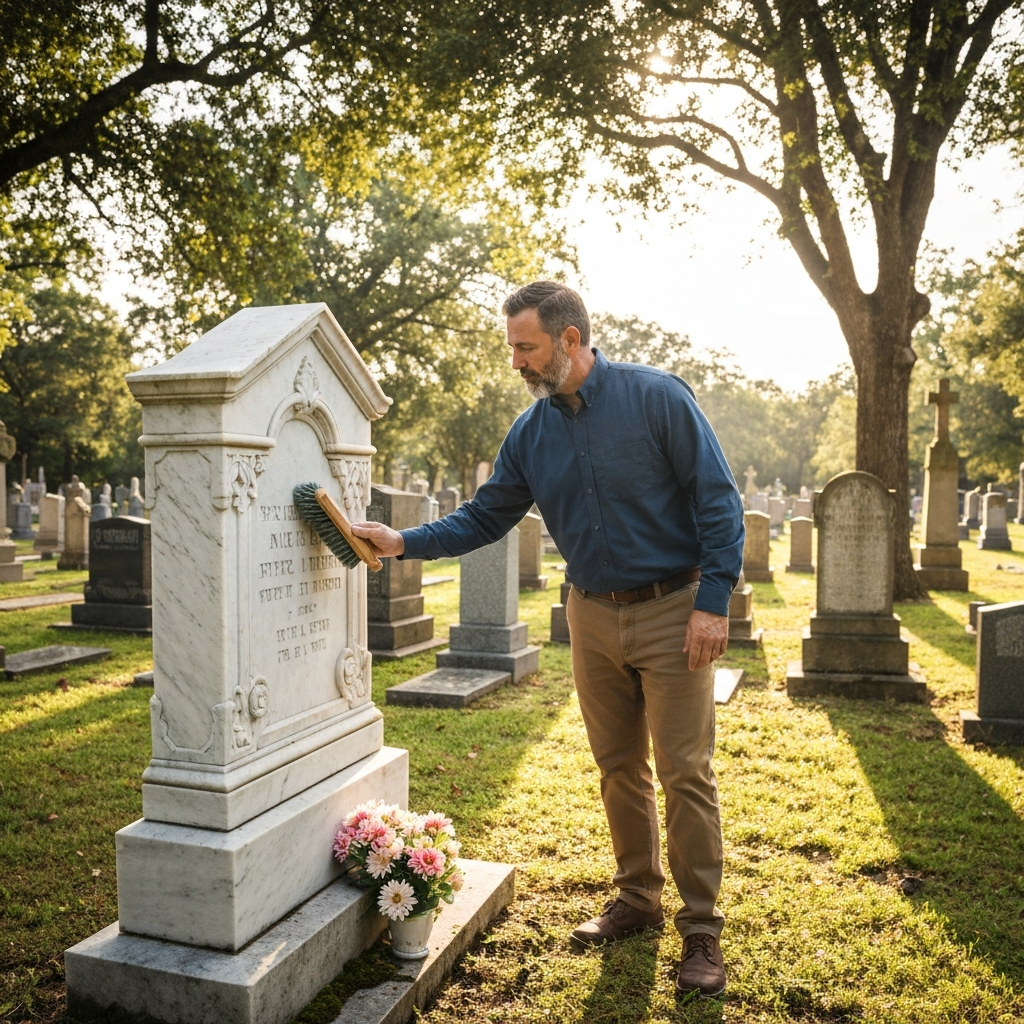
When families visit a cemetery and see that a loved one's headstone has become dirty, illegible, or covered in moss and lichen, their first instinct is often to grab a bucket, some household cleaning supplies, and get to work. It comes from a place of deep love and respect. Unfortunately, without the proper knowledge, tools, and chemicals, this well-intentioned effort can cause permanent, irreversible damage to the memorial.
In this comprehensive guide, we will walk you through the professional standards for headstone cleaning, explaining what to do, what never to do, and why professional methods are essential for the long-term preservation of cemetery monuments.
The Golden Rule: Do No Harm
In the field of monument restoration and conservation, the guiding principle is "Do No Harm." The goal of cleaning a headstone is not to make it look brand new, as if it were just carved yesterday. The goal is to safely remove harmful biological growth and environmental pollutants, restoring legibility while preserving the stone's natural patina, age, and historical integrity. Any cleaning method that removes the surface of the stone, alters its chemical composition, or accelerates its deterioration is strictly prohibited by conservation standards.
Step 1: Preparation and Permission
Before touching a monument, it is crucial to ensure you have the right to clean it. If you are not a direct family member, you must obtain permission from the family or the cemetery management. Many cemeteries have strict rules regarding who can perform maintenance and what chemicals or methods are allowed on their grounds. Always respect the rules of the cemetery.
Step 2: Evaluating the Stone's Condition
This is perhaps the most critical step, and one that is often skipped by amateurs. Before any cleaning begins, the monument must be thoroughly inspected for stability and soundness.
- Stability: Gently press on the stone. Is it loose on its base? Is it leaning dangerously? If a stone is unstable, it poses a severe crushing hazard and should not be touched until it is professionally reset and secured.
- Flaking and Delamination: Look closely at the surface of the stone, particularly on slate, sandstone, and older marble. Are there visible cracks? Is the face of the stone separating into layers? If the stone is actively flaking, cleaning it will cause those pieces to fall off, destroying the inscription forever.
- Sugaring: Gently rub your hand across a marble or limestone monument. If it feels like fine sand or sugar is falling off the stone, it is "sugaring." This means the binder holding the stone together has dissolved (usually due to acid rain). These stones are incredibly fragile and require highly specialized chemical consolidation before any physical contact can be made.
If a stone exhibits any of these signs of severe deterioration, it should only be handled by a professional conservator.
What NEVER to Do: Dangerous Cleaning Methods
The majority of damage done to monuments today is caused by improper cleaning. You must avoid the following methods at all costs:
Never Use Bleach or Household Cleaners
Chlorine bleach (sodium hypochlorite) is highly alkaline and contains soluble salts. When applied to porous stone, the bleach soaks in. As the water evaporates, the salts are left behind inside the stone. These salts crystallize and expand, creating immense internal pressure that causes the stone to spall, flake, and shatter from the inside out. Furthermore, household cleaners like glass cleaner, dish soap, or bathroom scrubbers often contain harsh acids or bases that will chemically alter and dissolve the stone.
Never Use Pressure Washers
High-pressure water is devastating to cemetery monuments. On polished granite, it can strip away the protective finish. On softer stones like marble and limestone, a pressure washer acts like a sandblaster, instantly carving grooves into the stone and obliterating fragile carvings and lettering. It also forces water deep into the stone's core, which will cause massive damage during the next freeze-thaw cycle.
Never Use Wire Brushes or Abrasive Pads
Metal bristles, stiff plastic scrub brushes, and abrasive scouring pads will scratch the surface of the stone. These microscopic scratches provide new, deeper anchors for biological growth to take root in the future. Additionally, wire brushes leave behind microscopic metal shavings that will rust, causing permanent orange stains on the monument.
The Professional Cleaning Process
Proper monument cleaning requires patience, the right tools, and monument-safe solutions. At Kentucky Monument Care, we follow the strict guidelines established by the National Center for Preservation Technology and Training (NCPTT).
The Right Tools
- Soft-Bristle Brushes: We use natural Tampico fiber brushes or very soft nylon brushes. A good rule of thumb is that if a brush is too stiff to comfortably rub on your own skin, it is too stiff for a historic monument.
- Wooden or Plastic Scrapers: To gently remove thick moss or lichen without scratching the stone.
- Pump Sprayers: For applying water and cleaning solutions gently and evenly.
- Clean Water: Copious amounts of clean water are required for rinsing. We often bring our own water supply to ensure we have enough.
- Biological Cleaners: We use professional-grade, quaternary ammonium compounds (like D/2 Biological Solution) that are specifically formulated and approved for use on historic monuments.
1. Dry Removal
If there is loose debris, thick moss, or heavy soil on the stone, we gently remove it using a soft wooden or plastic scraper. We never force or aggressively scrape; we only remove what comes off easily.
2. Thorough Pre-Wetting
Before applying any cleaning solution, the stone must be thoroughly soaked with clean water, starting from the bottom and working up. Because stone is porous, a dry stone will immediately suck the cleaning solution deep into its core. By pre-wetting the stone, we fill those pores with clean water, ensuring that the biological cleaner stays on the surface where the algae, moss, and lichen are actually located.
3. Application of Biological Cleaners
We apply the professional biological cleaner evenly across the monument, again working from bottom to top to prevent streaking. These specialized solutions are designed to safely break down the cellular walls of biological organisms without harming the stone itself.
4. Dwell Time
Patience is key. The cleaner must be allowed to sit on the stone (dwell time) for 10 to 15 minutes. During this time, the solution is actively killing the biological growth. We continuously mist the stone with more cleaner or water to ensure it does not dry out during this phase.
5. Gentle Agitation
Using our soft-bristle brushes, we gently agitate the surface in small, circular motions. We let the chemical solution do the heavy lifting; the brushing is simply to loosen the dead biological matter. We frequently rinse our brushes in clean water to avoid rubbing dirt back into the stone.
6. Extensive Rinsing
Once the stone has been gently scrubbed, it must be rinsed extensively with clean water. We rinse from the top down, ensuring all debris and cleaning solution is washed away. A monument cannot be over-rinsed.
The Concept of "Time is the Best Cleaner"
For stones that are heavily soiled with decades of lichen and black fungi, a single cleaning visit will drastically improve the appearance, but it may not remove 100% of the staining immediately. This is where professional biological cleaners truly shine.
After the initial cleaning and rinsing, we often apply a final, light mist of the biological cleaner and leave it on the stone. Over the next few days, weeks, and months, this residual cleaner continues to break down the deep-rooted biological growth. Every time it rains, the natural weather cycles reactivate the cleaner, gently washing away more of the dead organisms. Often, a stone will look significantly cleaner three months after our visit than it did on the day we cleaned it.
This is why our Full Restoration service often involves multiple visits. We apply the treatment, allow time for it to work naturally and safely, and then return to gently remove the loosened growth. This patient approach guarantees the safety and preservation of the monument.
Dealing with Specific Stains
While biological growth is the most common issue, monuments can suffer from other types of staining that require specific, careful approaches:
- Rust Stains: Often caused by iron dowels inside the stone or metal urns placed on top. Rust cannot be removed with biological cleaners and requires specific, monument-safe iron-reducing chemicals.
- Hard Water Scale: White, crusty deposits caused by cemetery sprinkler systems. This requires gentle, localized treatment with specific mild acidic cleaners formulated for granite (never used on marble).
- Tree Sap and Tar: Require careful application of specific, safe solvents that will break down the sticky substance without penetrating and staining the stone further.
The Importance of Ongoing Maintenance
Once a headstone has been professionally restored, it is much easier to keep it looking beautiful. However, because the monument remains outside in the elements, biological growth will eventually return. This is why Kentucky Monument Care offers Memorial Care Plans. Regular, gentle maintenance cleanings prevent the deep rooting of lichen and the heavy accumulation of fungi, ensuring the monument remains pristine and legible year-round without ever requiring heavy restoration again.
Conclusion
Cleaning a headstone is a beautiful act of remembrance, but it carries a heavy responsibility. The monuments in our cemeteries are irreplaceable historical records and sacred tributes to the lives lived before us. By avoiding dangerous household chemicals and aggressive methods, and instead relying on professional, scientifically proven conservation techniques, we can ensure that these stones endure. If you have a family monument that needs attention, trust the professionals at Kentucky Monument Care to restore it safely, respectfully, and beautifully.
Need Professional Monument Care?
Let Kentucky Monument Care safely restore your loved one's memorial using professional, monument-safe methods.