Wandering through any historic cemetery in Southern Kentucky, you will notice a wide variety of monument styles, shapes, and colors. Over the centuries, the materials chosen for headstones have evolved significantly, driven by changing tastes, advancements in carving technology, and transportation capabilities. Each type of material ages differently, reacts uniquely to the environment, and requires a completely distinct approach to cleaning and maintenance.
At Kentucky Monument Care, identifying the specific material of a memorial is always our first and most important step. A cleaning method that is perfectly safe for one type of stone could completely destroy another. In this comprehensive guide, we will explore the characteristics, history, and specific care requirements of the most common monument materials: Granite, Marble, Limestone, and Bronze.
Granite: The Modern Standard of Durability
Today, the vast majority of new headstones are made of granite. Granite is an igneous rock, formed deep within the earth from cooling magma. It is composed primarily of quartz, feldspar, and mica, which give it its characteristic speckled appearance and incredible hardness.
History and Characteristics
While granite has been around forever, it didn't become the standard for cemetery monuments until the late 19th and early 20th centuries. Prior to that, it was simply too hard to carve detailed inscriptions into granite using hand tools. With the advent of pneumatic carving tools and sandblasting in the early 1900s, granite quickly replaced marble as the material of choice due to its superior durability.
Granite comes in a wide variety of colors, including traditional grays, deep blacks, vibrant reds, and rich mahogany browns. It can be polished to a mirror-like finish or left rough and rustic (often called "rock pitch").
Vulnerabilities
Granite is incredibly resistant to weathering and acid rain, but it is not impervious to the elements. The highly polished surfaces tend to stay cleaner longer, but they are very susceptible to hard water stains. If a cemetery sprinkler system consistently hits a polished granite stone, the calcium and minerals in the water will bake onto the surface in the sun, creating a stubborn, cloudy white scale.
The unpolished areas of a granite monument—such as the carved lettering, frosted panels, and rough edges—are highly porous. These areas are magnets for dirt, pollen, and biological growth. Lichen, in particular, loves to anchor itself into the rough, unpolished crevices of granite.
Care and Cleaning Approach
Because of its hardness, granite can withstand a more thorough cleaning process than softer stones. We use professional biological cleaners to break down the lichen and algae in the unpolished areas. For granite, we can use slightly firmer (though still safe and non-wire) brushes to agitate the growth out of the deep carvings. Hard water scale requires a completely different approach, utilizing specialized, monument-safe descalers that dissolve the calcium without dulling the polish. Pressure washers should still never be used, as they can strip the polish and blast out the lithichrome (the paint used to highlight carved letters).
Marble: Historic Elegance and Fragility
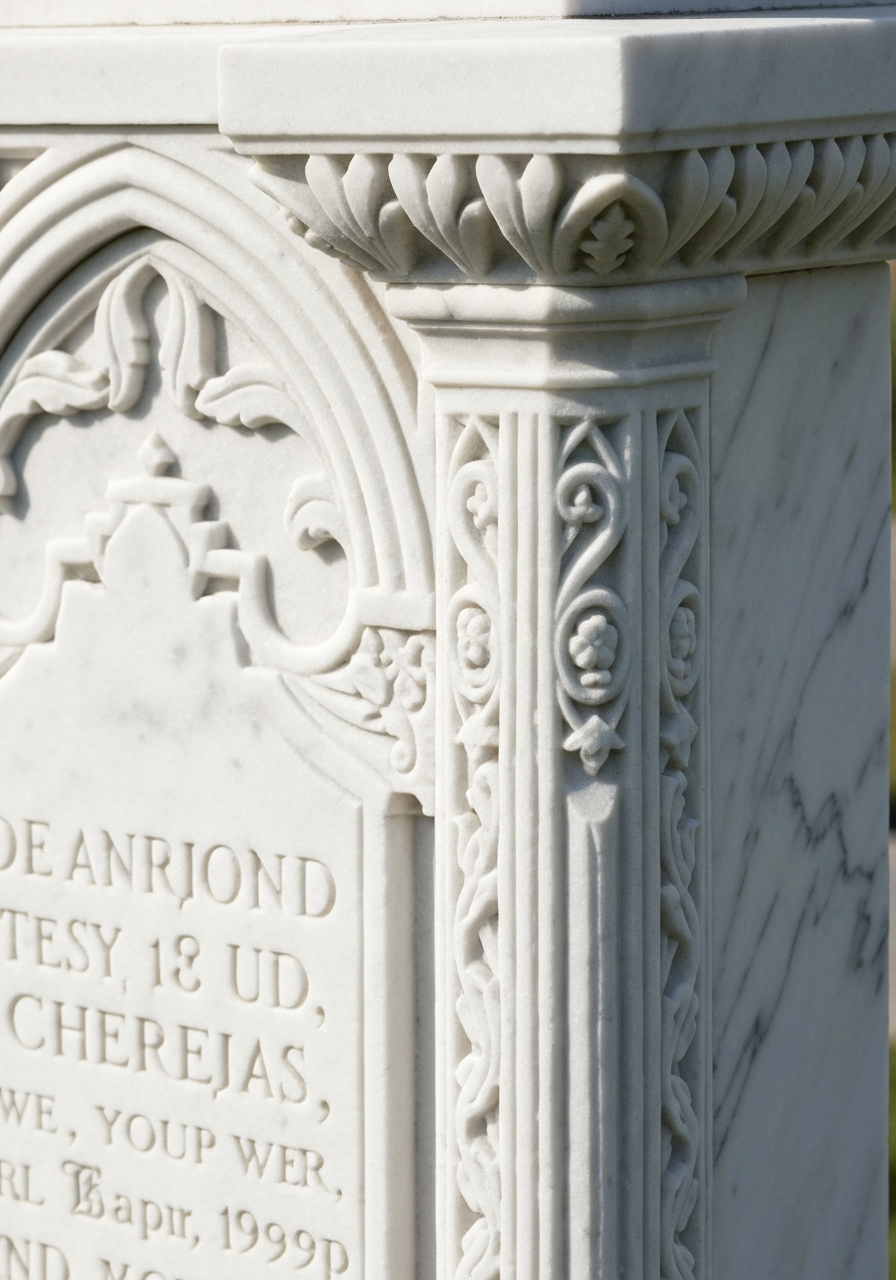
When you picture a historic, 19th-century cemetery, you are likely picturing marble. Marble is a metamorphic rock, formed when limestone is subjected to intense heat and pressure over millions of years. It is composed primarily of calcium carbonate.
History and Characteristics
Marble was the dominant monument material throughout the 1800s. It was favored because it was relatively soft and easy to carve by hand, allowing artisans to create incredibly detailed, beautiful sculptures, weeping willows, lambs, and intricate lettering. When new, white marble gleams brilliantly in the sun.
Vulnerabilities
Unfortunately, the very characteristics that made marble easy to carve make it highly vulnerable to the environment. Because it is calcium-based, marble reacts violently to acids. Acid rain literally dissolves the stone over time. This process causes the marble to lose its sharp details, making the inscriptions soft, blurry, and eventually completely illegible.
This deterioration often manifests as "sugaring," where the surface of the stone becomes granular and rubs off like fine sand. Marble is also highly porous, meaning it deeply absorbs moisture, dirt, and biological growth. It is common to see marble stones turn completely black from fungal growth or green from algae.
Care and Cleaning Approach
Marble requires extreme caution and the gentlest possible touch. Aggressive scrubbing will permanently remove the fragile, sugaring surface layer, taking the historic inscription with it. We rely almost entirely on specialized chemical cleaning for marble. We apply professional biological treatments that safely dissolve the black fungi and algae chemically over time, minimizing physical contact with the fragile stone. Bleach or acidic cleaners will instantly destroy marble and must never be used.
Limestone: The Local Heritage Stone
Limestone is a sedimentary rock composed largely of the minerals calcite and aragonite, which are different crystal forms of calcium carbonate. It often contains visible fossils and shells.
History and Characteristics
Limestone was frequently used for monuments before the widespread transport of marble and granite, especially in areas where limestone was quarried locally. It is a softer, porous stone, usually gray or tan in color.
Vulnerabilities
Like marble, limestone is calcium-based and highly susceptible to acid rain and environmental weathering. Because it is highly porous, it holds moisture well, making it a prime target for severe biological growth. Limestone monuments frequently become covered in thick moss and heavy black fungi.
Care and Cleaning Approach
The cleaning approach for limestone is very similar to marble. It requires gentle biological treatments and extremely soft brushing. Because the biological growth is often deeply rooted in the porous stone, limestone frequently requires multiple treatments over several months to safely draw out the staining without damaging the soft stone surface.
Bronze Markers: Timeless Patina
Bronze is not a stone, but a metal alloy consisting primarily of copper, usually with tin as the main additive.
History and Characteristics
Bronze is most commonly used for flat grave markers (often required in memorial park-style cemeteries) or as architectural plaques attached to granite bases. It is cast in foundries and offers incredible precision for lettering and sculptural reliefs. When new, bronze has a bright, metallic brown or gold appearance, which is protected by a factory-applied clear coat.
Vulnerabilities
As the protective clear coat inevitably wears away due to sun and weather, the bronze is exposed to the elements. The copper in the bronze reacts with moisture and oxygen (oxidation), developing a green or dark brown patina. While a light, even patina is often considered beautiful and desirable, heavy oxidation can make the marker illegible.
Bronze is also highly susceptible to hard water scale from sprinklers, which leaves chalky white deposits. Additionally, if bronze is attached to a stone base with improper hardware, it can cause galvanic corrosion.
Care and Cleaning Approach
Bronze cannot be cleaned with the biological chemicals used on stone. It requires a completely different restoration process. We clean bronze using gentle, non-ionic detergents and very soft brushes to remove dirt, bird droppings, and loose oxidation without scratching the metal. Once the bronze is clean and completely dry, it must be protected. We apply specialized, microcrystalline conservation wax, which is gently heated and buffed into the metal. This wax restores the deep, rich luster of the bronze and provides a protective barrier against future oxidation and moisture.
Sandstone and Slate
While less common in modern Southern Kentucky cemeteries, you may occasionally encounter very old sandstone or slate markers. Sandstone is highly prone to delamination (flaking off in large sheets) and must be treated with the utmost care, often avoiding any physical cleaning at all. Slate is incredibly durable and holds sharp carvings for centuries, but can be brittle and prone to cracking if subjected to pressure.
Customized Care is Essential
As you can see, there is no "one size fits all" approach to monument care. A chemical that safely removes hard water from granite will permanently dissolve a marble headstone. A brush that is safe for unpolished granite will scratch and ruin a bronze plaque.
This is why professional expertise is so critical. At Kentucky Monument Care, our deep understanding of geology, material science, and conservation standards ensures that every monument receives a customized care plan. By identifying the material, assessing its condition, and applying the correct, monument-safe methods, we ensure that your loved one's memorial is preserved safely, respectfully, and beautifully for generations to come.
Need Professional Monument Care?
Let Kentucky Monument Care safely restore your loved one's memorial using professional, monument-safe methods.